




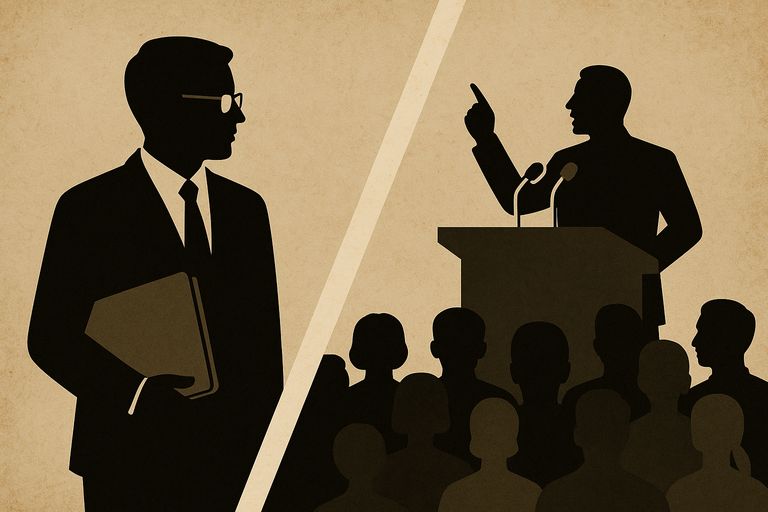
India has a habit of reaching for the same magic trick whenever politics looks too grubby. Someone says the solution is simple: bring in “good” people. Retired Civil Services officers, professors with neat handwriting, schoolteachers with moral authority, corporate professionals who know how to make PowerPoints and conduct meetings on time. They are presented as disinfectant for a system that looks too contaminated to fix from within. It sounds noble. It also has a remarkable record of failure.Not because these people are bad. But because they misunderstand the place they are walking into.
Politics in India is not a dirty room waiting for a broom. It is a living ecosystem with its own logic, codes and power circuits. People who try to enter it with a moral mop often get electrocuted.
Administration and Politics Are Two Different Species
Administrators believe in rules. Politicians believe in relationships. It really is that simple. A bureaucrat’s authority flows from the state. A politician’s authority is borrowed from society. One is trained to enforce the law. The other must understand what happens to people when the law meets real life.
Professionals arrive in politics thinking they can govern by neat file notes and strict schedules. They quickly discover that politics is theatre, negotiation, arm-twisting, crisis management and emotional intelligence rolled into one. Constituents do not care how efficiently you ran a district. They want to know if you are the kind of person they can call at 2 a.m. when a nephew is picked up by the local police.
Most professionals are not prepared for that shift. They enter with Excel sheets. Politics hands them a village with five factions that have not spoken to one another since 1994.
Elections Reward Belonging, Not Pedigree
White-collar entrants mistake credentials for currency. A UPSC rank or a PhD may impress TV studios. It does not impress a farmer whose canal has not been repaired for three seasons. Voters do not choose the candidate who sounds smartest. They choose the one who sounds familiar. The one who knows which family is feuding with whom, who owes money to whom, who needs help with a land record and who must be approached through a neighbour. These are not inefficiencies. This is the daily grammar of Indian democracy.
A professional who appears once every five years cannot compete with a local leader who has been a fixture at every wedding, funeral, temple event and public meeting for decades.
Most Professionals Arrive in Politics After Their Best Years
There is a reason political careers begin young. Politics requires stamina, appetite for risk and the ability to absorb rejection without falling apart. You cannot form a political base in a retirement year. A cadre can not be built when your instinct is to avoid conflict. You cannot learn booth-level politics when you spent thirty years believing that hierarchy protects you. Politics protects no one. It has no cushion and no sympathy card. Professionals who arrive late enter as tourists, not players. The electorate can smell that from a distance.
The Hardest Truth: They Misread Social Cues and Appear Arrogant
This is the point polite society avoids saying out loud. Most white-collar professionals do not know how to talk to the voters they want to represent. Their body language is stiff, vocabulary is unfamiliar. Their idea of a conversation is a lecture. They do not pick up on local humour, cultural nuance or the coded ways in which grievances are expressed. Very often, they do not even realise how aloof they look.
A teacher or bureaucrat may be respected in their controlled environment. But in a constituency filled with people poorer and less educated than them, they often project unintentional condescension. Not because they mean to, but because they have never had to adjust to a world where their authority is not automatically accepted.
Voters catch this instantly. The moment people think a candidate considers them “lesser” or “unsophisticated,” the candidate is finished. No amount of honesty or integrity will fix that perception.
Representative democracy is built on identification. If the voter sees the candidate as an outsider diagnosing their problems from a safe height, the bond collapses. They will choose someone flawed but familiar over someone brilliant but distant. Every time.
Politics Runs on Human Infrastructure, Not Files and Systems
Every constituency has a buzzing political underbelly. There are caste networks, religious bodies, trader groups, contractors, youth collectives, women’s circles, festival committees and informal power brokers. A politician must maintain a relationship with each of them. This is not corruption. This is social engineering.
Professionals often recoil at this. They prefer clean lines, single points of contact and formal meetings. Politics gives them chaos. It gives them ten competing demands arriving at the same time. It gives them a hundred small fires that must be put out before lunch. If you are uncomfortable with disorder, politics will eat you.
The Myth of Moral Cleansing Is a Convenient Shortcut
People cling to the belief that clean individuals can purify politics because it feels easier than fixing the structural problems. Funding opacity, centralised party control, weak institutions and zero transparency in candidate selection cannot be solved by parachuting one honest professor into Parliament. Good people in a bad system become mascots, not reformers.
Where Professionals Matter and Where They Do Not
India absolutely needs experts. It needs bureaucrats, technocrats, academics and professionals to design policy and run institutions. That is where their skills shine. But electoral politics requires another talent entirely. It requires rootedness, cultural fluency, physical stamina and the strength to absorb social chaos without losing balance. Good governance can come from professionals. Good politics comes only from people who understand the language of the street.
The Real Path to Better Politics
Indian democracy will not improve because a few white-collar entrants take the moral high ground. It will improve when political parties democratise internally, when fresh leaders rise from the grassroots and when institutional incentives reward transparency over patronage.
Until then, the dream of “clean candidates” fixing politics will remain exactly what it has always been: a comforting illusion.


1 Comment
Bhajan-Clubbing and Urban India’s Gen Z: A Sociological Perspective
November 16, 2025[…] over social media with the crowds dancing, chanting, and vibing with the same intensity you would expect at a concert. Except this time, the “performer” on stage is a Kirtan artist, not a mainstream […]