


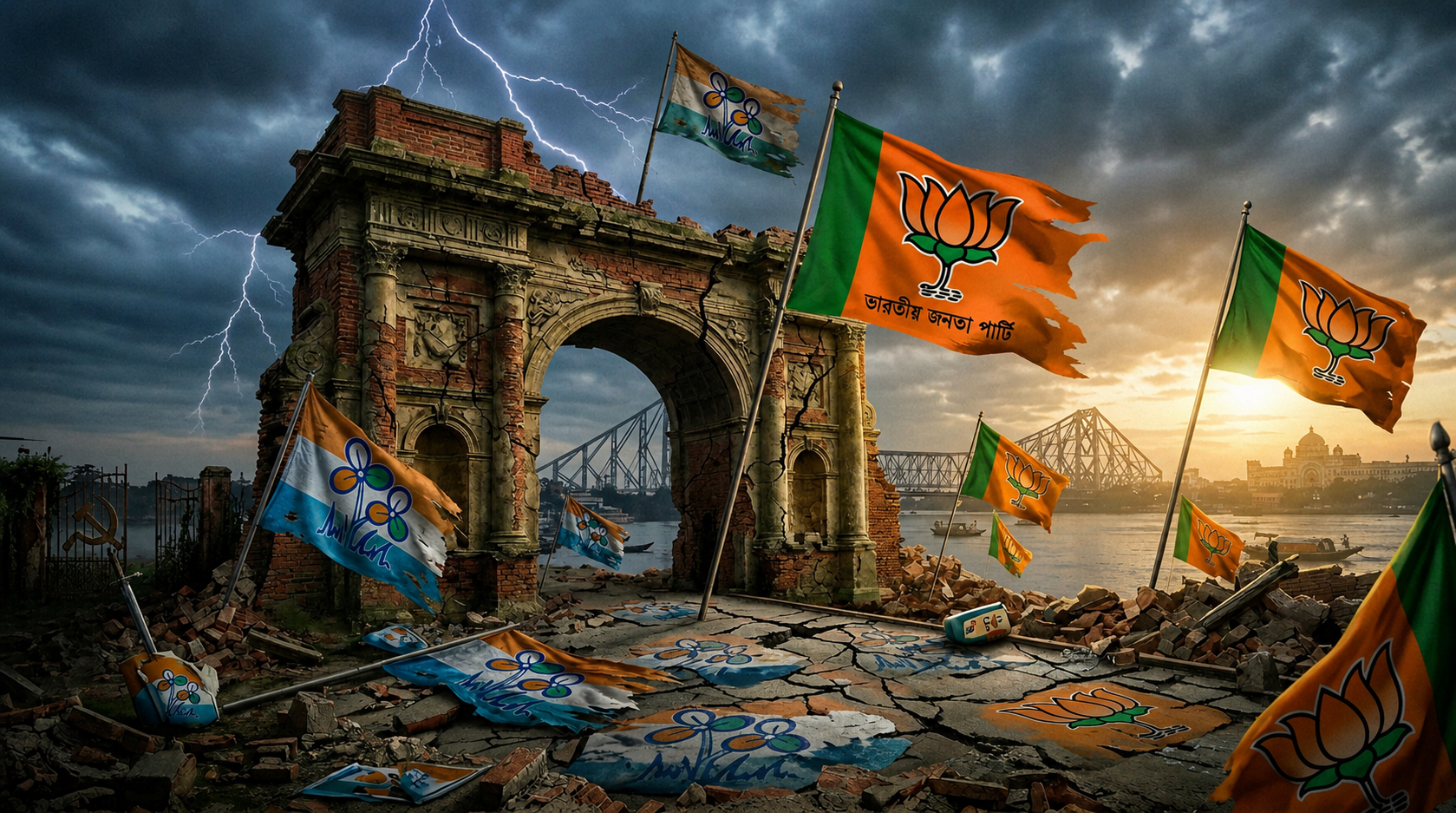

The political landscape of Bengal today resembles a grand estate where the masonry is cracked and the foundations hollowed out. For over a decade, the Trinamool Congress (TMC) occupied this structure, not through the strength of an idea, but through the inheritance and management of a ruin. As the Bharatiya Janata Party (BJP) prepares to breach the gates, we are witnessing more than just a change in administration; we are witnessing the inevitable collapse of a party that possessed no inner life.
The Ideological Void
The primary affliction of the TMC is its profound intellectual barrenness. To survive the long arc of history, a movement requires a core; it needs a philosophy that transcends the charisma of a single leader or the distribution of spoils.
The TMC possesses neither a political ideology nor an intellectual class to articulate one. It is a party of the moment, for the moment. It sustained itself by colonising the state institutions perfected by the CPM.
The Left in Bengal spent decades building a totalitarian apparatus that blurred the lines between the party and the police, the cadre and the civil servant. When the TMC took over, they did not dismantle this machinery; they simply changed the mechanics.
This reliance on institutional capture rather than visionary governance explains their limitation. It is why, despite their dominance within the borders of Bengal, they remain a parochial entity, unable to export their brand of politics beyond the local landscape. They stayed in power not because they were loved for their vision, but because they were feared for their control.
The Coming Dissolution
As the BJP ascends, its first order of business will be the systematic dismantling of its chief rival. For a party like the TMC, which is held together by the gravity of power, the loss of that power would be fatal. Without a coherent ideology to bind the rank-and-file during the lean years of opposition, the party will likely evaporate. We have seen this before. In the Indian subcontinent, when a populist party built on patronage loses the ability to patronise, its members do not stay to fight, they migrate to the new center of gravity.
The disappearance of the TMC will not be a slow fading; it will be a collapse into a vacuum. And in politics, as in nature, a vacuum is an invitation for the most potent forces available to rush in.
The Rise of the Subcontinental Surge
If the TMC vanishes, the political equation of Bengal could reset to its most primal elements. Bengal’s demographic reality is that it is home to arguably around 35-40% Muslim population. That cannot be ignored. For years, this vote bank was managed and mediated by the Left first and then the TMC. Without an intermediary to consolidate these votes, the stage would be set for a surge of identity politics.
Whether this void is filled by the Indian Secular Front (ISF), an expansion of the Hyderabadi influence of Owaisi, or a radical outfit like Jamaat, the result would be the same: the emergence of a distinct Muslim political movement. This would shift the battlefield away from development or regional pride toward a starker, more existential confrontation.
The Final Battleground
One observes a curious trend across the subcontinent. The CPM, once the indomitable master of the East, has now been reduced to a ghost in Bengal and is currently witnessing its twilight in Kerala. As these old, mid-century structures fail, they leave behind a polarised landscape.
Bengal remains uniquely positioned to be the crucible of this new era. If the middle ground, one that was occupied by the TMC, erodes, we would then be left with a direct confrontation: the Hindu nationalist project versus a concentrated Muslim political surge. This is not merely a provincial skirmish; it is a preview of the subcontinent’s future.
History teaches us that Bengal has often been the laboratory for India’s political destiny. The party that eventually emerges victorious from this “final battle” in the region will hold the keys to the rest of the subcontinent.
In hindsight, the TMC, in its intellectual shallowness, was a mere placeholder. The real struggle for the soul of the region is only just beginning, and it will be fought over the ruins of those who had power but no purpose.