




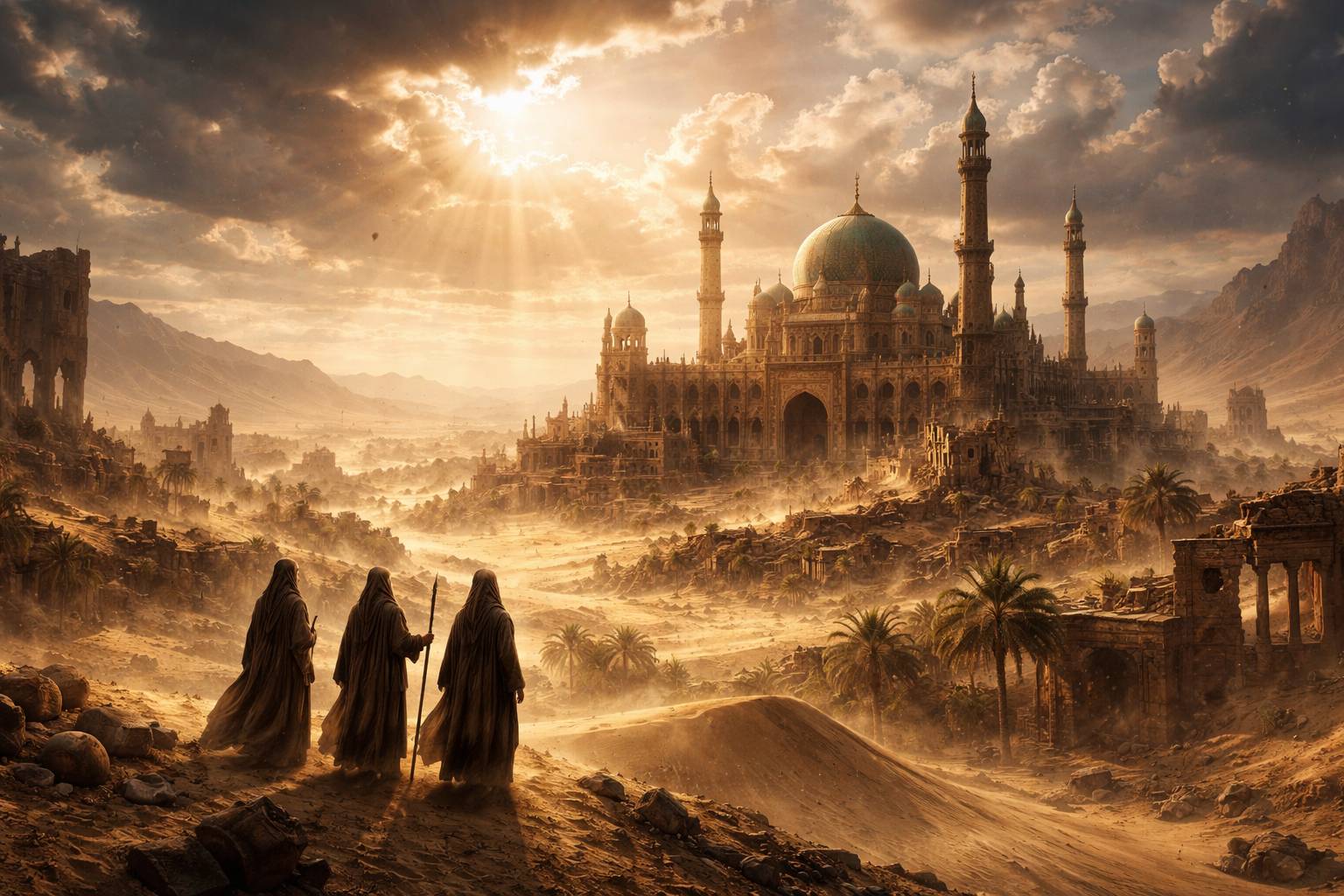
The modern state of Iran is an attempt at cartographic compression, a political box forced upon a geographical soul that once spanned central, west, and middle eastern Asia. To travel the Iranian plateau today is to experience a profound paradox of a nation defined by its defiant sovereignty yet haunted by the memory of ancient Persia; each tensely feeding off the other.
The tension remains between the transient reality that is present-day Iran and the eternal idea that was ancient Persia. This is a source of creeping melancholy which underlines the sense that an original, flexible, and spiritual vision has been replaced by a survivalist, rigid structure that contributes to a modern chaos that is philosophical as much as political.
This profound sense of loss permeates the entire region. It is not merely the mourning of heritage or the erasure of old stones; it is the shattering of a spatial destiny. It is the geopolitical equivalent of a heart that once pulsed for nearly half a continent, now confined to a single, narrowed artery.
Spiritual Capaciousness and the Unfixed Centre
The original geopolitical magic of Persia was its spiritual capaciousness. That capaciousness was never strict monotheism in practice; it was a geographically embodied polytheism: an ability to let many gods, many truths, many centres breathe inside the same imperial body. The empires of the Achaemenids and Sasanians, the architects of the first great continental civilisation, did not succeed through singular dogma, but through a profound, polytheistic tolerance of space. The early Zoroastrian ethos that centred on ethical choice and cosmic order (Asha) did not police the divine; it orchestrated it. Darius could inscribe himself king of kings, while Egyptian Amun-Ra, Hebrew Yahweh, and Babylonian Marduk still receive their offerings under the same imperial sky.
This was an imperial philosophy that did not demand a single, fixed centre, but rather a central, flexible administration woven over local diversity.
When Faith Mirrored the Road
Their power was inherently nomadic in its administration, relying on vast, flexible networks of roads, couriers, and the shared lingua franca of Persian to manage a realm that stretched from the Aegean to the Indus. The spiritual structure was a mirror of the physical. The imperial soul was geographically polytheistic. It could absorb, manage, and even celebrate the differences in the Caspian and the Indus without collapsing into ideological conflict.
This heritage of flexible connectivity is the fundamental loss. When thinkers of today speak about the Silk Road being reborn, they refer to, in a blinkered sense, an economic vision of reunification. But the land in its deep memory, remembers the original spiritual and cultural unity, the time when Samarkand, Baku, and Baghdad were not foreign points of conflict or trade treaties, but simply parts of the same continuous historical conversation.
Ideological Singularity and Geopolitical Retreat
The geopolitical tragedy of modern Iran is rooted in the eventual victory of ideological singularity. That flexible, poly-cultural imperial soul was ultimately suffocated by the victory of ideological singularity – first in late Sasanian orthodoxy, finally and irreversibly in the Arab-Islamic conquests that imposed a jealous God, a single qibla-facing umma, and the psychological necessity of a defensible frontier. This philosophical rigidity made the subsequent territorial compressions in the shape of the loss of the Caucasus, or the Mesopotamian heartlands, the alienation of the Central Asian khanates, not just tactical defeats but existential implosions. Persia, the civilization, was driven behind mountain ranges and deserts until all that remained was Iran – a small, brooding, half-estranged national project that still dreams in the wrong language and thinks along the wrong scale. Today, Iran’s political structure is necessarily rigid because it constantly fights its own soul that yearns for a larger, unfettered civilizational and cultural horizon.
Interiority versus the Uncontained Soul
This inherent spatial loss gives rise to the unique texture of Iranian leadership culture today: a deep, almost defiant interiority. The lost heritage has not been annihilated; it has simply been driven inward, becoming a necessary refuge from geopolitical constraint.
But among the Iranians this “loss” is not static; it is active. Iranians are not merely mourning the past; they are wrestling with the future, trying to navigate a “Eurasian Age” where they are conceptually ready for continental connectivity, but politically blocked by religious and ideological constraints of their leaders that were designed by circumstances beyond their control. Hafez and Rumi, poets who never belonged to ‘Iran’ but to the entire lost Persianate world, remain the living cipher of that vanished universality.
That cipher carries the memory of the ancient, expansive, and geographically tolerant Persian spiritual identity. The Persian language itself acts as the ultimate nomadic instrument, moving silently across national boundaries, connecting Tajikistan to the Persian Gulf and from there to the Caspian Sea, reminding people that their historical identity is too vast to be contained by a visa or a political flag.
The question that one finds hanging in the air of ancient cities of Isfahan, Shiraz, or Tabriz is not what Iran is, but how Persia should be. The answer offered by history is a region defined by spiritual flexibility; the answer offered by the Iranian leadership is a small, hard shell defined by ideological singularity. And amidst today’s chaos of sanctions, paranoia, or the revolutionary exhaustion, it is probably the same history of this far greater, polyvalent spiritual power that is trying, after fourteen centuries, to break out of its cage.
Arindam Mukherjee is the author of Contours of the Greater Game – Access, Control, and Geopolitical Orders (BluOne Ink); A Matter of Greed (IED Press); and JourneyDog Tales (Zero Degree Publishing).

1 Comment
Resilience In Gulf Is Rooted in a History of Managed Instability
February 9, 2026[…] occupied a strategic space between competing powers. Ottoman influence extended from the north, Persian authority shaped the eastern flank, and British imperial interests dominated maritime routes from India […]