



India is a constitutional democracy. Its citizens are guaranteed the right to freedom of speech and expression under Article 19, and the freedom of religion under Article 25. These protections are not merely symbolic; they are foundational.
If members of any community wish to mourn the death of a religious or political leader abroad, they are within their rights to do so. Prayer gatherings, expressions of grief, religious observances, and commemorative events fall squarely within constitutional protection, provided they remain peaceful and lawful. The issue, therefore, is not whether Shias have the right to mourn. They do.
"The children in my womb will also become martyrs for Khamenei and Islam"
— Megh Updates 🚨™ (@MeghUpdates) March 2, 2026
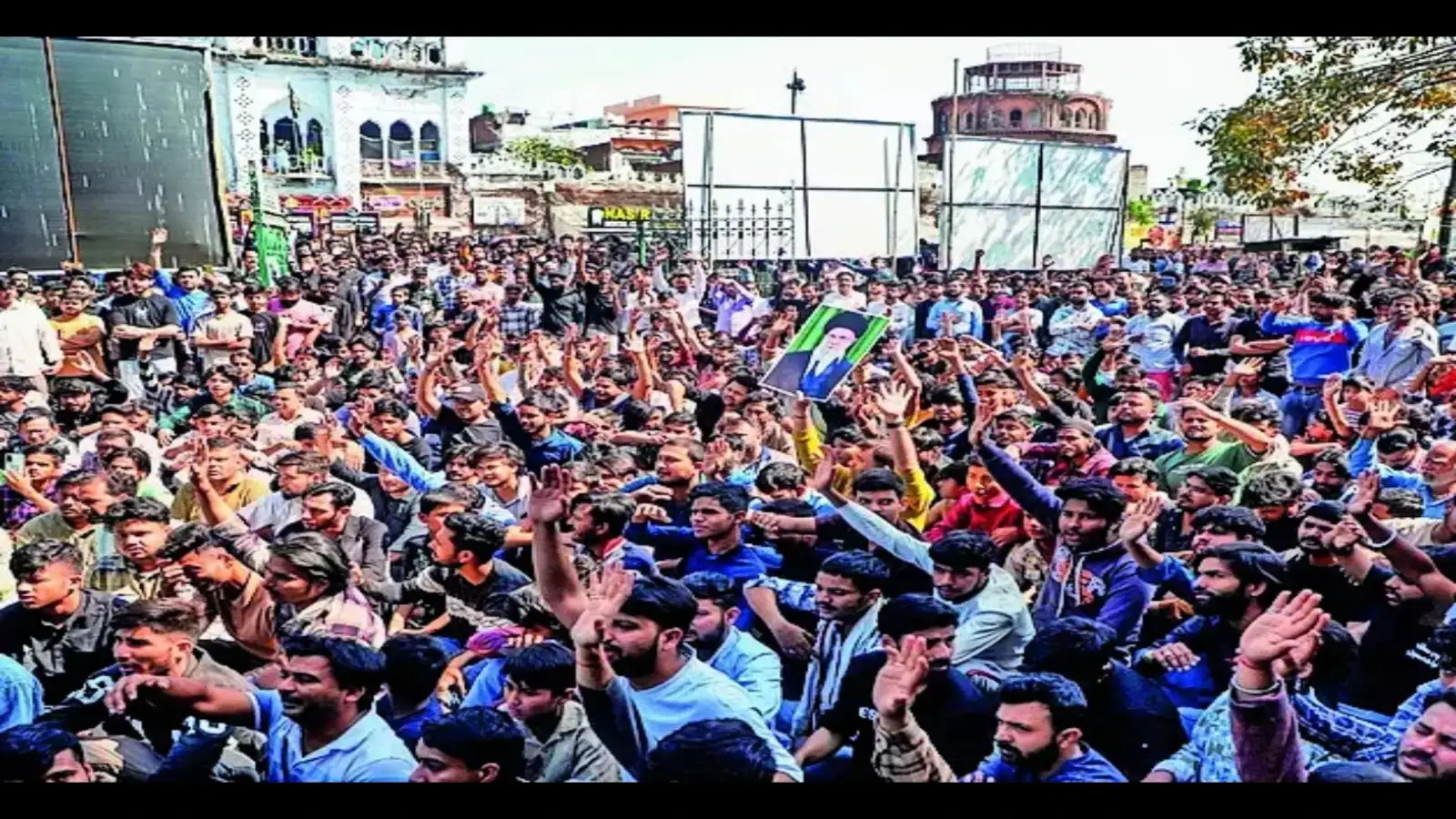
:A woman in the protests in Delhi over Khamenei's death. pic.twitter.com/efBREUnsRv
The issue is what happens when mourning transforms into political mobilisation on Indian streets over a foreign power struggle. That is where the conversation changes.
Grief Is Emotional. Mobilisation Is Political.
Grief is inward. Mobilisation is outward. A prayer gathering in a mosque is spiritual. A march carrying political symbolism linked to a foreign state is strategic signalling. Even if participants do not intend it that way, the optics are unavoidable. Public street protests are not neutral acts. They are political performances. They communicate power, solidarity, alignment, and sometimes opposition.
When the subject of that mobilisation is a foreign leader embedded in a complex West Asian geopolitical contest, the act is no longer merely devotional. It becomes part of a broader narrative ecosystem. And that ecosystem is not domestic.
India is not a theatre in the Iran–Saudi rivalry. It is not a frontline in US–Iran tensions. It is not a proxy space for Middle Eastern ideological battles. When street protests mirror those external tensions, even symbolically, they blur India’s sovereign boundaries. That blurring is strategically unwise.
India’s West Asia Balancing Act
India’s foreign policy in West Asia is built on careful equilibrium. New Delhi engages with Iran for connectivity, energy, and regional access. It deepens defence and investment ties with Saudi Arabia. It has built one of its strongest strategic partnerships in the region with the United Arab Emirates. Simultaneously, it maintains robust cooperation with Israel in technology and security.
Visuals from Lalchowk Srinagar #kashmir #Khamenei #Khamenei #Iran pic.twitter.com/Rk14aUtUWt
— Koshur newton (@KoshurNewton) March 1, 2026
This balancing act is deliberate. It protects India’s energy security, safeguards its diaspora, and sustains trade flows across a volatile geography. Domestic political mobilisation tied to a specific foreign leader or faction can complicate this delicate equilibrium. It creates perceptions. Perceptions influence diplomatic atmospherics. Diplomatic atmospherics influence strategic outcomes.
Foreign policy is not only conducted through embassies. It is also observed through optics. A sovereign state must therefore be mindful of how its internal streets reflect on its external posture.
The Illusion of Impact
There is also a hard strategic truth that must be acknowledged. Protests in Indian cities will not alter the political trajectory of Tehran. They will not influence succession structures within clerical hierarchies. They will not change American policy. They will not shift Gulf alignments. Symbolism does not equal leverage.
For a community to mobilise domestically over an external political figure may offer emotional catharsis, but it does not produce geopolitical outcomes. It risks domestic friction without yielding international impact. A mature polity must evaluate actions not only on moral grounds but on strategic efficacy. If the act changes nothing abroad but introduces tension at home, its utility must be questioned.
Domestic Stability Is a Strategic Asset
India’s internal cohesion is not incidental. It is a strategic asset. The country houses multiple sects within Islam, along with a vast spectrum of other religious traditions. It has historically absorbed diversity without allowing external sectarian conflicts to define its internal order.
"Mere sher Khamenei ko dhokhe se mara….wo kal bhi sher tha aur Qayamat tak sher rahega"
— BALA (@erbmjha) March 1, 2026
Hijabi Ayesha from Lucknow is more heartbroken than Iranians 🤡 pic.twitter.com/EbFe6D8WB3
Once transnational rivalries begin to manifest through domestic mobilisation, the precedent becomes difficult to contain. Today it may be one foreign leader. Tomorrow it may be another regional conflict. Gradually, the street becomes a canvas for external emotional spillover. That path weakens sovereignty. A confident republic must guard against becoming an extension of someone else’s ideological battlefield.
The Line Between Expression and Alignment
There is a subtle but important distinction between expressing grief and appearing aligned in foreign factional politics. India’s Constitution protects expression. It does not mandate political alignment with external state actors.
When public mobilisation mirrors the symbolism, slogans, and imagery associated with a particular geopolitical bloc, it risks being interpreted as more than mourning. Whether fairly or unfairly, such perceptions can harden domestic narratives and external interpretations alike. The responsibility, therefore, lies not only with the state but also with community leadership to exercise prudence. Restraint is not weakness, it is strategic.
A Republic Must Choose Stability Over Spectacle
India can be compassionate without being performative. It can allow mourning without enabling geopolitical theatre. It can protect religious freedom without encouraging transnational political signalling. This is not a call for suppression. It is a call for proportionality.
A confident community does not require street mobilisation to validate its grief. A confident state does not permit its public spaces to become echo chambers of distant rivalries. In a volatile world, stability is strength. And governance requires the wisdom to distinguish between emotion and strategy. Mourning is a right. Turning foreign power struggles into domestic protest cycles is not.