








The report published by Rutgers University Law School- Hindutva in America: A Threat to Equality and Religious Pluralism is not an academic document. It’s a political sermon disguised in footnotes. Before it even defines its subject, it delivers the verdict: “Hindutva is a transnational far-right ideology grounded in Hindu supremacy.”
That one sentence sets the tone, not of inquiry, but indictment. The rest of the 63 pages read like a charge sheet written by ideological missionaries pretending to be scholars. What Rutgers has built is not a centre for rights, but a pulpit for moral policing, where Hindu belief is placed under permanent suspicion.
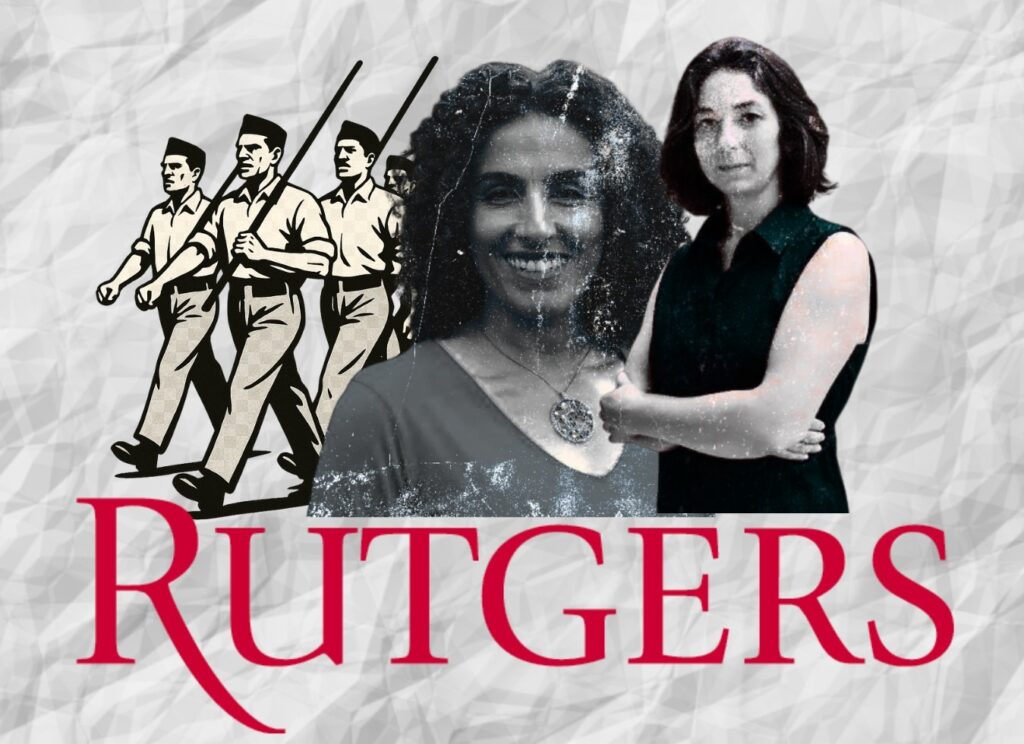
The conceit is always the same: Hindutva equals extremism; Hindu equals Hindutva; therefore Hindu life equals extremism. A complete community, millions strong, is dragged into a courtroom it never asked to enter.
The Genealogy of a Fixation
Western academia’s obsession with Hindus is not new. It began with British Orientalists who exoticised Hindu civilisation as sensual, chaotic, and primitive. Post-colonial America simply rebranded that prejudice as “progressive critique.”
To the modern Western professor, “Hindutva” is not a movement but a mirror, reflecting their unease with any non-Western confidence. They baptise their anxiety with jargon: “majoritarianism,” “fascism,” “supremacy.”
This is not scholarship. It is ritual cleansing. Hindus become the sin that must be purged for Western liberalism to feel morally pure. The term “Hindutva” is no longer descriptive- it’s diagnostic, a pathology label for civilisational pride. So when Rutgers invokes “Hindutva,” what it really fears is an India that refuses to behave like a cultural colony.
From Orientalism to Activism
The Rutgers CSRR has perfected the art of ideological laundering, turning activism into scholarship. Its sources are not peer-reviewed journals but advocacy blogs, Twitter threads, and activist collectives like SASAC and DGH.
Their citations read like an echo chamber: the same people citing each other, cross-tagging, and grant-hunting through moral outrage. And always, the same keywords, “supremacy,” “casteism,” “violence.”
In this ecosystem, evidence is optional, but accusation is currency. The goal is not understanding, but conversion: Hindus must confess their privilege, apologise for their civilisation, and submit to academic re-education. CSRR calls it “critical scholarship.” A better term would be ‘academic evangelism’, a modern pulpit where Abrahamic guilt becomes the yardstick for judging a non-Abrahamic civilisation.
America’s New Blasphemy Law
What Rutgers proposes under the banner of “security” is an intellectual blasphemy law for Hindus. It demands universities “educate themselves about Hindutva-inspired discrimination” and protect professors from “Hindu nationalist intimidation.”
Translated: shield activists from criticism, punish dissenters, and make Hindu students walk on eggshells. In this new theology, to celebrate Diwali is fine, as long as it’s framed as an “inclusive multicultural event,” not a civilisational affirmation.
To disagree with this framing is to risk being labelled “extremist.” The Inquisition has returned — only this time, it carries DEI badges and endowment grants. This is how freedom dies in academia: not with bans, but with bureaucratic virtue.
The Machinery and Its Priests
At the centre of this ideological enterprise sits Professor Sahar F. Aziz, a law academic who directs Rutgers’ CSRR. A self-styled expert on “Islamophobia and civil rights,” she has turned CSRR into a pulpit for selective activism. The centre publicly claims to champion “marginalised voices,” yet its targets are strikingly uniform: Hindu, Indian, and pro-India civic groups.
CSRR’s publications, all under Aziz’s oversight, borrow heavily from advocacy collectives like the South Asia Scholar–Activist Collective (SASAC) and Dismantling Global Hindutva (DGH), the same circuits where Rutgers’ own Professor Audrey Truschke is a visible presence.
Truschke, a historian of the Mughal period, has long blurred the line between scholarship and activism. She co-authored the “Hindutva Harassment Field Manual”, a document accused by diaspora groups of smearing dissenters as extremists. Her lectures and social media feed often function less as history and more as political agitation, all protected under the university’s academic sanctity.
Together, Aziz and Truschke embody a new kind of academic priesthood: one that decides who is righteous enough to be called pluralist and who must be excommunicated as “Hindutva.”
The Shadow Economy of Activism
Behind this intellectual crusade lies an opaque financial network. CSRR’s own website lists donation channels like the “Humanising Palestine Endowment”, and accepts funds through ideological partners such as the New Jersey Muslim Lawyers Association and Awad & Khoury Law Firm.
Yet the same report that demands Hindu organisations “disclose foreign links” refuses to publish its own donor list or institutional affiliations. Even the U.S. Senate Judiciary Committee, in early 2024, reportedly questioned whether CSRR receives foreign or taxpayer-funded grants, an inquiry sparked by concerns over anti-India bias.
Investigations by diaspora watchdogs like COHNA and Voice of Hindus have highlighted this hypocrisy: Rutgers’ centre functions as a moral court for Hindu civic life while operating with zero transparency about its own funders.
The pattern is unmistakable, anti-Hindu rhetoric is not a byproduct of scholarship; it’s a funding model. Each outrage produces visibility, each visibility attracts grants, and each grant sustains the next round of “studies.” It’s not an academic movement. It’s a monetised ideology with a university logo.
Policing the Sacred
What truly irritates these self-appointed moral arbiters is not “Hindutva” per se, it’s Hindu autonomy. Hinduism doesn’t seek converts. It doesn’t fit into the West’s binary of believer versus heretic. It is decentralised, philosophical, and fundamentally non-Abrahamic. It doesn’t need saving, and that infuriates the saviour complex of Western academia.
So they invented a moral scalpel called “Hindutva.” It allows them to amputate Hindu identity into manageable pieces, “ritual,” “folklore,” “mythology,” “extremism”, while erasing its civilisational coherence. Once reduced to pathology, it can be “treated” through “caste sensitivity training,” “diversity workshops,” and “anti-bias frameworks.” It’s a colonial therapy session disguised as pedagogy.
The Cowardice of Silence
If the Rutgers report is an act of aggression, then the silence of Hindu intellectuals is an act of surrender. Too many community leaders respond with politeness, begging for inclusion in the very structures that demean them. But appeasement doesn’t buy respect, it buys contempt. You cannot negotiate with a narrative designed to erase you.
The Hindu diaspora must reclaim moral confidence. Build think tanks, endow chairs, publish counter-scholarship, litigate bias, name the hypocrisy. Stop outsourcing civilisational legitimacy to professors who’ve never read the Gita but quote Wikipedia on caste. Moral sovereignty is not granted; it is seized.
The Progressive’s New Exotic
Yesterday, they studied India as the “land of mystics.” Today, they study it as the “land of extremists.” The fetish has changed, not the posture. The Western academic still assumes moral ownership of India, whether he is romanticising it as “spiritual” or condemning it as “fascist.” Either way, the Hindu must remain an object, never a subject.
Rutgers’ report continues this colonial anthropology. It performs concern while reproducing hierarchy. It preaches equality while institutionalising prejudice. The missionary may have swapped his Bible for a bibliography, but the sermon remains the same: “We will define you. You will comply.”
Beyond Rutgers: The Weaponisation of Academia
This isn’t a campus quarrel; it’s the manufacturing of narrative infrastructure. The terms coined in Rutgers’ corridors travel into U.S. policy papers, think-tank memos, and media coverage.
“Hindutva networks,” “foreign influence,” “Hindu nationalism as extremism”, these phrases are linguistic weapons. They shape how India is viewed in Washington, how Hindu students are profiled in classrooms, how newsrooms frame Indian democracy.
Academic language becomes geopolitical ammunition. The goal is not to study India’s rise, but to morally manage it.
Reclaiming the Vocabulary of Pluralism
The counter to this is not censorship but counter-narrative. Hindus must reclaim their own vocabulary: Hindutva as civilisational self-respect, pluralism as dharmic harmony, equality as balance, not sameness. Western secularism demands uniformity; dharma celebrates multiplicity. The former flattens; the latter sustains.
When Rutgers calls Hindu assertion a “threat to equality,” what it means is a threat to Western monopoly over the definition of equality itself. They are not protecting diversity, they are protecting authorship.
A Civilisational Response
India and its diaspora must stop reacting and start architecting. Fund Hindu chairs in global universities, support serious scholarship, document bias, and create cultural institutions that are unapologetically civilisational.
Academic diplomacy is the new frontier. For every “Center for Race and Rights” that pathologises Hindu identity, build an “Institute for Civilisational Studies” that understands it on its own terms. This is not propaganda. It’s parity.
The Inquisition Meets Its Mirror
Rutgers’ report will not destroy Hindu civilisation, it will expose Western academia’s own fragility. Every witch-hunt reveals the insecurity of the inquisitor. The West, haunted by its fading moral monopoly, now lashes out at any civilisation that dares to stand without permission. The Hindu, calm and unconverted, becomes the mirror in which the empire sees its own decline.
The Inquisition may have a law-school logo today, but dharma has survived empires, crusades, and colonisers before. Rutgers will be forgotten. The civilisation it tried to indict will remain- quietly, patiently, infinitely alive.