






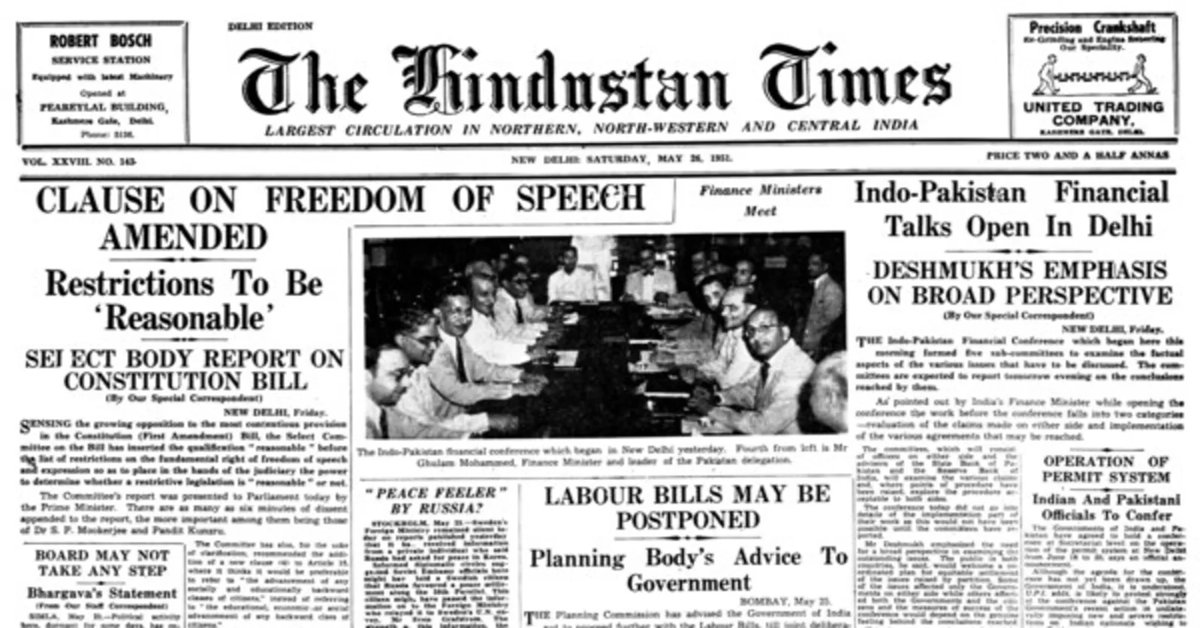
The Constitution (First Amendment) Bill, introduced by Prime Minister Jawaharlal Nehru in May 1951, ignited a fiery confrontation between the executive and the judiciary, forcing India’s first generation of leaders to choose between rapid social engineering and upholding expansive individual liberties. The debate witnessed deeply contrasting perspectives from India’s political and legal elite, ranging from the Prime Minister’s assertion of parliamentary supremacy to the Opposition’s fierce defence of constitutional rights.
Proponents of the Amendment: Prioritising Social Change
The core support for the amendment stemmed from Prime Minister Jawaharlal Nehru and key members of his Cabinet, who viewed the Constitution’s existing framework, particularly the Fundamental Rights, as an impediment to the Congress party’s flagship social and economic programs, such as zamindari abolition, nationalisation, and reservations for backward classes.
Nehru articulated his frustration openly, once thundering that the “magnificent constitution that we had framed was later kidnapped and purloined by lawyers”. He argued that core concepts of Fundamental Rights (individual liberty and freedom) were “relics of a static age” and “now passé”. These static ideas were, in his view, overtaken by the dynamic principles of social reform and social engineering enshrined in the Directive Principles of State Policy.
Nehru declared that the courts, by stressing justiciable fundamental rights over the non-justiciable Directive Principles, were hindering the “whole purpose” of the Constitution itself. He insisted that it was “impossible to hang up urgent social changes because the Constitution comes in the way”. His solution was “straightforward – to bend the Constitution to the government’s will, overcome the courts and pre-empt any further judicial challenges”. On the floor of Parliament, Nehru dismissed critics’ arguments as having relevance “some hundreds of years ago but which have no relevance now”. He assured the House that he was merely giving effect to the “real intentions of the framers of the Constitution”.
Dr. B. R. Ambedkar, the Law Minister and Chairman of the Drafting Committee, despite having previously described individual rights as the “very soul of the Constitution and the very heart of it”, supported the amendment as a necessary measure. He argued that judicial pronouncements, particularly those regarding the Communal GO (Madras Order on reservations), were “utterly unsatisfactory” and not in consonance with the Constitution. He helped enable the amendment by recommending changes to curtail the Supreme Court’s power to determine the propriety of limitations on fundamental rights. When questioned on the need for the Ninth Schedule, Ambedkar tersely replied that examining every section of the acts for constitutionality would impose an undue burden on the ministries.
C. Rajagopalachari, the Home Minister, represented a deep-seated desire within the establishment to reassert state power. His ministry drafted recommendations seeking to expand the grounds for curbing free speech to include “public order” and “in the interests of the security of the State,” and recommended dropping the word “reasonable” from restrictions to avoid judicial oversight. Earlier, before the Constitution’s inauguration, Rajagopalachari had expressed the view that the country “must restore the unqualified reverence for the state that our ancients cultivated”.
The Constitutional Opposition: Defenders of Freedom
The most trenchant criticism of the amendment came from a disparate band of forces, including opposition leaders, eminent jurists, and disillusioned Congress members. They framed the debate as the “first battle of Indian liberalism”, a fight to preserve the expansive freedoms originally granted by the Constitution.
Dr. Shyama Prasad Mookerji, the unofficial Leader of the Opposition, led the counter-attack, charging that the bill was “Cutting at the very root of the fundamental principles of the constitution”. He called it the “beginning of the encroachment of the liberty of the people of Free India”. Mookerji questioned Nehru’s motives, asking if he threw this “challenge” due to “fear” or a belief that he was incapable of governing unless “clothed with more and more powers to be arbitrarily utilized”. Mookerji also directed a ferocious attack against the Ninth Schedule, calling it a “constitutional monstrosity” and arguing that deliberately removing laws from judicial scrutiny made the Constitution a “scrap of paper”. He warned Nehru about the dangerous precedent being set, questioning what would happen if a different party came into authority later.
Acharya Jivatram Kripalani, a Gandhian stalwart and Congress rebel, resigned from the party amidst the parliamentary combat. He agreed that land reform might necessitate constitutional change, but stressed that the country was also solemnly pledged to freedom of speech, which was now being abridged. Kripalani accused the government of relying on “idol worship” (of Nehru) to remain in power. He used glacial sarcasm to warn the Prime Minister: “More power will only injure you. So please be satisfied with limited power, because your capacity is very limited indeed”.
Other parliamentary opponents included:
- Hriday Nath Kunzru, who accused the government of proposing powers not exercised even during the British regime in peacetime and declared that Articles 19 and 31 were being effectively repealed.
- Hari Vishnu Kamath, who suggested that the government should amend its policies, not the Constitution. He called the Ninth Schedule “nothing short of midsummer madness”.
- Maharaja Kameshwar Singh (a zamindar who led the legal fight against land acts), accused Nehru of “sowing the seed of executive despotism” and “playing with the supremacy of the Constitution for party advantage”.
- Frank Anthony, an Anglo-Indian MP, reluctantly supported the bill only because he believed Nehru’s dictatorship was “the only way to prevent a later dictatorship, communist dictatorship”.
The Cautionary Voices: Institutional Integrity
Institutional leaders voiced profound reservations about the necessity, haste, and timing of the amendment:
President Rajendra Prasad, the highest constitutional functionary, vehemently objected to Nehru’s approach. He wrote to the Prime Minister that the Constitution held a “sanctity” that ordinary laws did not and should only be amended after all other methods were exhausted. Prasad was dismayed that the Fundamental Rights, which “stands above every other Part of the Constitution,” was the first to be assailed. He also objected to the provisional Parliament, elected on a limited franchise, undertaking such profound changes, advising that “expediency and propriety ought to dictate caution”.
Sardar Vallabhbhai Patel, before his death, had demonstrated caution regarding Nehru’s impulses. When Nehru questioned the restrictions placed by the Constitution on state action, Patel reminded him that the Constitution “guarantees fundamental rights… which further circumscribe the action we can take,” meaning every executive action needed “legal justification”.
External Critics and Jurists
Prominent legal and political figures outside Parliament echoed the sentiment that the government was prioritizing power over constitutional morality:
- P. R. Das, an eminent jurist, charged that India had become a “one-party state just as Hitler’s Germany was a one-party state” and argued that the provisional government had “no moral right to amend the Constitution without the verdict of the people”.
- M. R. Jayakar, a renowned legal luminary, feared that the government would interfere with fundamental rights as soon as they were found inconvenient, and urged citizens to be the “watchdogs of the Constitution”.
- The socialist leader Jayaprakash Narayan alleged that the Congress was “inexorably heading towards dictatorship” and later called it a “great tragedy that in a single-party Parliament the ruling party should take advantage of its majority to tamper even with Fundamental Rights”.
- The Nagpur High Court Bar Association declared the proposed amendments “improper, unjustified and highly undemocratic”.
In essence, the proponents saw the Constitution as a flexible tool to be wielded for the nation’s progress, while the opponents viewed the Constitution, particularly its Fundamental Rights, as a sacred, permanent check on executive tyranny – a difference in philosophy that shaped the future of Indian democracy.
The 1951 amendment debate served as a striking demonstration of conflicting democratic philosophies: the Nehruvian view prioritizing the “will of the people” (as represented by the parliamentary majority) to implement transformative social policies, versus the liberal view insisting that the Constitution itself, upheld by the judiciary, must remain inviolable against majoritarian legislative action.
(The article is based on the book, “Sixteen Stormy Days” by Tripurdaman Singh)
Wrtten By: kritant Mishra
Kritant is a Public Policy Consultant and head of an NGO (Anurudra Seva Foundation). He is interested in debate around the Constitution, Law, and Politics.